The best place to see dolphins in Murrells Inlet is a creek mouth on a moving tide, early in the morning, from something quiet. That last part is why a kayak beats a tour boat here. Bottlenose dolphins in this estuary are working animals — they’re hunting bait that the tide pushes around — and a kayak lets you sit still at the edge of a channel and let them come to you instead of motoring around looking.
No one can promise you dolphins. What you can do is stack the odds: right place, right tide, right hour, and enough patience to stop paddling.
Key takeaways
- Creek mouths on a moving tide are the highest-percentage spot. Falling water flushes bait out of the marsh and dolphins stage where it exits.
- Early morning and late afternoon are the best windows — calmer water, less boat traffic, and easier to spot a fin.
- Federal law requires distance. NOAA asks people to stay at least 50 yards from wild dolphins, and feeding or harassing them is illegal under the Marine Mammal Protection Act.
- Stop paddling and drift. More sightings come from sitting still than from chasing.
- Garden City, Oyster Landing, and the Pawleys creeks are the launches with the most consistent reports.
- Dolphins are the headline, not the whole show — herons, ospreys, rays, and sea turtles between roughly May and October are close to guaranteed.
Why a kayak beats a boat for this
Tour boats will find you dolphins, and they’re a fine day out. But a boat brings you to dolphins at speed, at a distance, with an engine running. A kayak lets you do the thing that actually produces good encounters: park yourself at a place dolphins use, shut up, and wait.
You’re also at eye level with the water. A dorsal fin cutting a creek twenty yards away is a different experience from six feet up on a deck. And because a kayak draws almost nothing, you can sit in the shallow water at the edge of a channel where a boat can’t go and watch dolphins work the deeper slot next to you.
The trade-off is that you have to know where to sit. That’s what the rest of this is.
Where: creek mouths on a moving tide
Murrells Inlet is a tidal estuary with roughly 16.5 miles of creeks draining into one inlet mouth. Every one of those creeks fills and empties twice a day, and everything small that lives in the marsh moves with the water.
Dolphins know this. They stage where the water concentrates.
The highest-percentage places to sit:
- Where a marsh creek empties into a larger channel. On a falling tide, bait gets funneled out of the creek into deeper water, and dolphins wait at the junction. Find a creek mouth, get out of the current, and drift.
- The main channel near the inlet. More dolphin traffic than anywhere else in the system — but this is also where the current runs hardest and the boats are busiest, so watch from the marsh edge rather than sitting in the channel itself. See our safety guide for why the mouth deserves respect.
- Deeper holes and channel bends in the middle creeks, where fish stack up as the water drops.
Tide stage matters as much as location. A slack tide is the worst time to look — the water isn’t moving, so the bait isn’t moving, so nothing is hunting. The first two or three hours of a falling tide are usually the most productive, with the incoming a close second. Dead high and dead low are the dead spots. Our Best Time to Kayak Murrells Inlet guide covers how to read the day’s chart.
When: the hours that work
Early morning, roughly 6 to 9 a.m., is the best single window. The water is glassy, which makes a fin visible from a long way off. Boat traffic hasn’t started. Everything in the marsh is active.
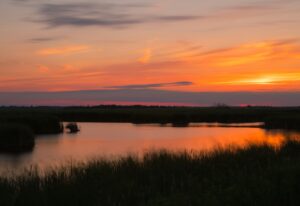
Late afternoon into the hour before sunset is second best, with the bonus that the light is spectacular. The downside in summer is thunderstorm risk, which builds through the afternoon on this coast.
Midday is the worst of the three: chop from wind and boat wake hides fins, glare off the water makes spotting hard, and the heat is punishing with no shade.
Polarized sunglasses are genuinely not optional for this. They cut surface glare and you’ll see fins, rays, and fish you’d otherwise paddle straight past.
Which launches
All thirteen public launches are mapped on our launch sites page, but three come up again and again in dolphin reports:
Garden City Boat Ramp. Dolphins are frequently spotted in the inlet near this ramp, and the creeks behind the strand give you plenty of junctions to sit at. Small free lot; go early.
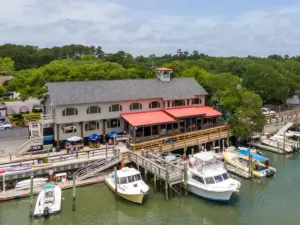
Oyster Landing. The main Murrells Inlet ramp, 112 free spaces, and direct access to the channel where dolphin traffic is heaviest. Launch, work back into the creeks behind the MarshWalk, and watch the junctions. Get there before 8 a.m. on a summer weekend or you’ll be sharing the water with a lot of outboards.
Pritchard Street Landing, Pawleys Island. A quiet hand launch into Pawleys Creek where dolphins are seen regularly. Parking is very limited — weekday mornings only, realistically.
If you want a full route rather than a spot to sit, the Oyster Landing marsh loop and the Garden City creeks run in our paddle route guide both pass good water.
How to actually watch them
Stop paddling. This is the whole technique. When you see a fin, put the paddle across your lap and let the boat drift. Dolphins are curious and they will often close the distance themselves. Paddling toward them ends the encounter almost every time.
Don’t chase, don’t circle, don’t cut them off. Beyond being counterproductive, it’s illegal. Wild dolphins are protected under the Marine Mammal Protection Act, and pursuing, circling, or otherwise altering their behavior counts as harassment.
Keep 50 yards. That’s NOAA’s guidance for viewing wild dolphins. If they choose to come closer than that, fine — hold your position and let them. The rule is about what you do.
Never feed them. Feeding wild dolphins is illegal and it’s the single most damaging thing people do to them. Fed dolphins learn to approach boats, lose their wariness, and end up injured by props and fishing gear. If you’re fishing from the kayak, don’t toss scraps.
Watch how they’re moving. Dolphins traveling in a straight line at a steady pace are going somewhere and won’t linger. Dolphins circling, surfacing irregularly, or working back and forth in one area are feeding, and that’s when you’ll get a longer look — from where you are.
Strand feeding, and why you shouldn’t go looking for it
South Carolina’s Lowcountry estuaries are home to one of the more remarkable behaviors in the animal world: strand feeding, where a small group of dolphins works together to drive fish up onto a mud bank, then lunges partly out of the water to grab them before sliding back.
Two honest caveats. First, it’s documented most consistently in the Charleston-area estuaries rather than here, so treat it as a rare bonus in Murrells Inlet, not something to plan around. Second, and more important: if you do encounter it, back off. Strand feeding happens on shallow mud banks at low tide, and dolphins that are disturbed mid-lunge can be pushed away from a food source or, worse, left high on the bank. Stay well clear, stay in the boat, stay quiet, and don’t approach the bank.
What else you’ll see
Dolphins are the headline. Nearly everything else on this list is close to a sure thing, which is why the trip is worth taking even on a day the dolphins don’t show.
Wading birds. Great blue herons, snowy and great egrets, tricolored herons, and night herons working the mud edges at close range. Clapper rails you’ll hear long before you see one.
Ospreys, on nearly every channel marker in summer, and bald eagles with real regularity in the river corridors.
Shorebirds, heaviest near the inlet mouth and the beach — terns, black skimmers, oystercatchers, plovers. Huntington Beach State Park at the south end of the estuary is considered one of the best birding sites in the Southeast, and paddling the causeway there puts you in the middle of it.
Rays, gliding under the boat in clear shallow water. Cownose rays move through in schools in spring, and cobia often shadow them.
Sea turtles, roughly May through October, most often near the inlet mouth and the jetty rather than back in the creeks.
Fiddler crabs by the thousand on exposed banks as the tide drops — wave a paddle and the whole bank moves at once.
Guided or on your own?
If you want the best odds on a single morning, go with a guide. Local kayak outfitters run the inlet daily and know which creek mouths are producing that week, which is knowledge you can’t get from a tide chart. Several run naturalist-led trips specifically built around wildlife. Our rentals and operators page lists who’s running what, and the cost guide covers what you’ll pay.
If you’re comfortable on the water and happy to play the odds, rent and go. Pick a creek mouth, go on the falling tide at 7 a.m., and sit.
Frequently asked questions
Are there always dolphins in Murrells Inlet?
Bottlenose dolphins are resident in South Carolina’s estuaries year-round, so they’re around. Whether they’re in the particular creek you’re sitting in on a particular morning is a different question. Sightings are common but never guaranteed, and any operator who promises them is overpromising.
What time of year is best?
Spring through fall gives you the most comfortable paddling and the most activity in the estuary generally. Dolphins are here in winter too — fewer people are.
Is it safe to be near dolphins in a kayak?
Yes. Wild dolphins are not interested in confrontation with a kayak and generally keep their own distance unless they’re curious. The rules exist to protect them from us, not the reverse. Give them room, don’t feed them, don’t chase.
Can I take my kids?
Absolutely — this is one of the better ways to keep a child interested for a full hour on the water. See our guide to kayaking with kids in Murrells Inlet for ages, gear, and the calmest launches. One piece of advice: don’t promise dolphins.
What should I bring?
Polarized sunglasses above everything else. Then a dry bag for your phone, sun protection, water, and a cheap pair of binoculars if you’ve got them.
Where do I report an injured or stranded dolphin?
Don’t approach it. Contact SCDNR — the 24-hour line is 1-800-922-5431 — and let trained responders handle it.
Check the current tide chart and the marine forecast before you launch, and see our launch site guide for parking and access notes on all thirteen public launches from Surfside Beach to Georgetown.