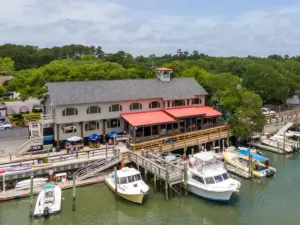
Murrells Inlet is one of the easier places on the South Carolina coast to put a kid in a kayak. The marsh creeks are flat, shallow, and sheltered from ocean swell, most trips stay within sight of the launch, and the wildlife is close enough that a six-year-old stays interested. The two things that actually decide whether the trip goes well aren’t the water — they’re the tide window you pick and how long you stay out.
Here’s the practical version: ages, who rides where, how to size a life jacket, the three calmest launches, and the logistics nobody writes about, like where the bathrooms are. (Short answer on that last one: mostly nowhere.)
Key takeaways
- Kids under about 7 ride tandem with an adult. Most of them can hold a paddle; almost none of them can hold a heading.
- South Carolina law requires anyone under 12 to wear a Coast Guard–approved life jacket on a vessel under 16 feet, which includes every kayak you’ll rent here.
- Go on the incoming tide, mid-morning. More water under you, less current to fight, and you’re off the water before the afternoon heat and thunderstorms.
- Plan for a shorter trip than you think. Under 6, budget 45 minutes to an hour on the water. It is much better to end while everyone’s still having fun.
- Huntington Beach State Park is the only one of the three good family launches with real restrooms. Morse Park has a playground and picnic tables and no bathroom at all.
- Operators set their own minimum ages and weights. Call before you drive over with a four-year-old.
What age can a kid start kayaking here?
There’s no legal minimum age to be in a kayak in South Carolina, so this comes down to the child and the operator. Rough guidance from what actually works on this water:
Ages 3–5. Possible, in the front of a tandem or seated between an adult’s legs on a wide sit-on-top, on a short and very calm trip. Realistically this is a twenty-to-forty-minute outing where the adult does all the paddling and the kid looks at crabs. Some rental operators won’t take children this young at all — ask first.
Ages 5–8. The sweet spot for tandem paddling. They can genuinely contribute with a kid-sized paddle, they’re old enough to follow an instruction like “stop paddling,” and they’re interested in the marsh. Keep it under an hour.
Ages 8–11. Many kids this age can handle their own sit-on-top on flat water with an adult within arm’s reach the whole time. “Can they swim confidently” matters more than the number on the birthday card. If you’re unsure, tandem is not a step backward.
Ages 12+. Effectively adult paddlers on this water, assuming reasonable fitness and a life jacket that fits. They can do any of the beginner routes in our paddle route guide.
The one caveat that applies at every age: rental operators set their own minimums, and some also have weight minimums for the front seat of a tandem. Check when you book — our rentals page lists who’s running what, and a two-minute phone call saves a wasted drive.
Tandem or solo?
The honest default for anyone under about ten is tandem, with the adult in the back.
The back seat steers. That’s the whole reason. A kid in the front can paddle as hard or as little as they want and the boat still goes where you point it. Put a young child in their own kayak and you’ll spend the entire trip towing, corralling, or shouting course corrections across twenty feet of water, which is nobody’s idea of a nice morning.
A few things worth knowing about tandems:
- Sit-on-top tandems are the rental standard here and they’re the right boat. They’re stable, they don’t fill with water, and if someone slides off it’s straightforward to climb back on.
- Give the kid a kid-sized paddle. An adult paddle is too long and too heavy, and a child fighting one will be done in ten minutes.
- Expect to do most of the work. Budget your own energy for the whole trip, not half of it.
When a kid does graduate to their own boat, the first solo trip should be somewhere you can reach them in three or four strokes — which brings us to where you launch.
Life jackets: the law, and the fit
South Carolina requires every person under 12 to wear a U.S. Coast Guard–approved Type I, II, III, or V PFD while on board a vessel under 16 feet. A kayak is a vessel under 16 feet. This isn’t a recommendation, it’s SC Code, and DNR officers do check. Full rules are on dnr.sc.gov.
Every rental operator provides life jackets and requires them. What they can’t guarantee is that the child sizes in the bin that day will fit your child, which is why the fit test matters more than the paperwork.
Sizing is by weight, not age. The standard categories:
- Infant: 8–30 lbs
- Child: 30–50 lbs
- Youth: 50–90 lbs
- Adult: 90+ lbs
The fit test: fasten every buckle and strap, then have the child raise their arms while you lift the jacket by the shoulders. If it slides up past their chin or ears, it’s too big — a jacket that rides up in the water pushes a child’s face down, not up. Look for a child-specific PFD with a crotch strap and a head-support collar; both exist for exactly this reason.
If you own a jacket that fits your kid well, bring it. It’s the one piece of gear worth hauling to the coast.
The three calmest launches for families
We cover all thirteen public launches from Surfside Beach to Georgetown on our launch sites page. These are the three that work with kids in the boat.
Oyster Landing — the practical choice
The main Murrells Inlet ramp, and the easiest logistics of the three: 112 free parking spaces (the most in the corridor), a multi-lane concrete ramp, and courtesy docks you can load a child into instead of balancing them on a muddy bank.
From here, launch and turn away from the inlet mouth, into the creeks behind the MarshWalk. The mouth is where the current concentrates and it’s no place for a family trip.
The trade-off is traffic. Oyster Landing gets busy on summer weekends with boat trailers and motor traffic, and kayaks sit low and are hard to spot. Arrive before 8 a.m. and most of that problem disappears.
Morse Park Landing — the one with the playground
The waterfront park on the south end of the inlet, with a small playground, shaded picnic tables, a boardwalk, a crabbing dock, and the Lost at Sea Memorial. Culturally this is the family spot in Murrells Inlet, and the hand launch into Alston Creek is quiet in a way the main ramp never is.
Two real caveats. Parking is limited and got tighter after recent park work — arrive early or plan to drop gear and park elsewhere. And Alston Creek drains to mud at low tide, so this launch is strictly a high-water proposition. Put in two hours before high water and be back within an hour after.
The playground is the secret weapon: if the paddle ends early, you haven’t wasted the drive.
Huntington Beach State Park causeway — the one with bathrooms
Launch from the causeway inside the park, with calm water on both sides — a freshwater lagoon on one and salt marsh on the other. The wildlife here is the best of the three by a distance, which for a kid is the entire point.
Park entry is $8 per adult, and that fee buys you the thing the other two launches don’t have: actual restrooms, plus a beach. Paddle in the morning, get lunch, put them on the sand in the afternoon. It’s the easiest full family day on this list.
Note that alligators live in the freshwater lagoon side. In practice they avoid boats and people, but keep kids close, never feed one, and give any you see a wide berth. Our safety guide covers this in more detail.
Bathrooms, parking, and the stuff nobody writes about
This is the section that will actually save your morning.
Bathrooms. Huntington Beach State Park has them. Morse Park does not — no restroom, not even a portable one, despite the playground and the crowds. Assume the same at the other ramps unless you’ve confirmed otherwise. Handle this before you leave the rental, and treat it as a hard constraint on trip length for anyone recently potty-trained.
Parking. Oyster Landing has 112 free spaces and is the only launch in the area where parking isn’t a factor. Morse Park’s lot is small, uneven, and fills fast. Huntington Beach has ample parking behind the entry gate.
Timing. Mid-morning on a rising tide, roughly two hours either side of high water. Early morning is the calmest water but a hard sell with young kids; midday is brutally hot with no shade on the marsh; and summer afternoons on this coast bring thunderstorms with little warning. Mid-morning splits the difference. See Best Time to Kayak Murrells Inlet for the full breakdown.
Cost. Self-guided rentals run roughly $15–25 an hour and guided tours around $45 per person, so a family of four is usually a modest afternoon rather than a major expense. Full numbers are in our cost guide.
How long before it turns
The single most common mistake families make here is staying out too long. Rough ceilings, assuming reasonable weather:
- Under 6: 45 minutes to 1 hour
- 6–10: 1 to 1.5 hours
- 10–13: up to 2 hours
- 14+: adult pacing
Build the return leg into that number, not on top of it. If you’re an hour out, you’re two hours total, and the second hour is the one where a five-year-old discovers they are finished.
End while they still want more. That’s how you get asked to come back tomorrow.
What to pack for kids specifically
Beyond the usual sunscreen, hat, water, and dry bag:
- A kid-sized paddle. Ask the operator; most have them.
- A change of clothes in the car. Non-negotiable. Everyone gets wet and pluff mud does not come out of white shorts.
- Water shoes or old sneakers. Never flip-flops. Oyster shell is sharp and mud pulls shoes off feet.
- A long-sleeve sun shirt. There is essentially no shade on the marsh, and it beats reapplying sunscreen to a squirming child.
- Snacks. More than you think. Hunger and heat compound fast.
- A cheap pair of binoculars. Turns twenty minutes of paddling into an hour of looking for birds.
What they’ll actually see
This is what keeps a kid engaged, and Murrells Inlet delivers on it.
Fiddler crabs by the literal thousand on the banks as the tide drops — one wave of a paddle and the whole bank moves. Great blue herons and snowy egrets standing close enough to count feathers. Ospreys on the channel markers. Rays gliding under the boat in clear shallow water. Oyster beds surfacing as the water falls, ticking and popping as they dry.
And dolphins, which work the channels and creek mouths and turn up often enough to be worth watching for, though never often enough to promise. Don’t promise. If they show up, it makes the trip; if they don’t, nobody’s disappointed.
Guided trip or rent-and-go?
If your kids are comfortable in boats and you’re confident reading a tide chart, rent and go. The Oyster Landing loop is about as low-stakes as paddling gets.
Consider a guided trip if it’s your first time on this water, if you’ve got more kids than competent adults, or if you want somebody else carrying the responsibility for timing and route. Several local operators run family-friendly tours and know exactly which creeks are holding water on a given day. See our rentals and operators page, or tell us your group and we’ll match you to the right one.
Frequently asked questions
What’s the minimum age to kayak in Murrells Inlet?
There’s no legal minimum, but rental operators set their own — commonly somewhere between 4 and 6 for a tandem front seat, and often a weight minimum too. Call ahead rather than assuming.
Do my kids need to know how to swim?
It’s strongly recommended and it changes what’s sensible. A confident swimmer can reasonably try their own kayak around 8–10; a non-swimmer should stay tandem with an adult regardless of age. Tell the operator either way so they can size the life jacket carefully and point you at the calmest route.
Is it safe with alligators around?
Alligators are present in the brackish upper creeks and the freshwater lagoon at Huntington Beach State Park, and encounters from a kayak are uncommon. They avoid boats and people. Keep kids close, don’t feed or approach one, and keep paddling if you see one. The realistic risks on this water are tidal current and boat traffic, not wildlife — more on that here.
Can we bring a toddler?
Some operators allow it in a tandem with a properly fitted infant or child PFD, some don’t. If you do, keep it very short, go at high water, and stay within a few minutes of the launch.
What if the weather turns while we’re out?
Get off the water. On the beginner routes you’re rarely more than fifteen or twenty minutes from a launch. Check the forecast alongside the tide chart before you go, and don’t push a marginal afternoon in summer — lightning over open marsh is genuinely dangerous.
Can we do this on paddleboards instead?
A small child can ride on the nose of an adult’s board on a flat, calm morning at the right tide. It’s a shorter, wetter, more precarious trip than a tandem kayak, and it’s not the choice for a first outing.
Conditions change and facilities do too. Check the current tide chart and the marine forecast before every trip, and see our launch site guide for parking, ramp type, and access notes on all thirteen public launches from Surfside Beach to Georgetown.